


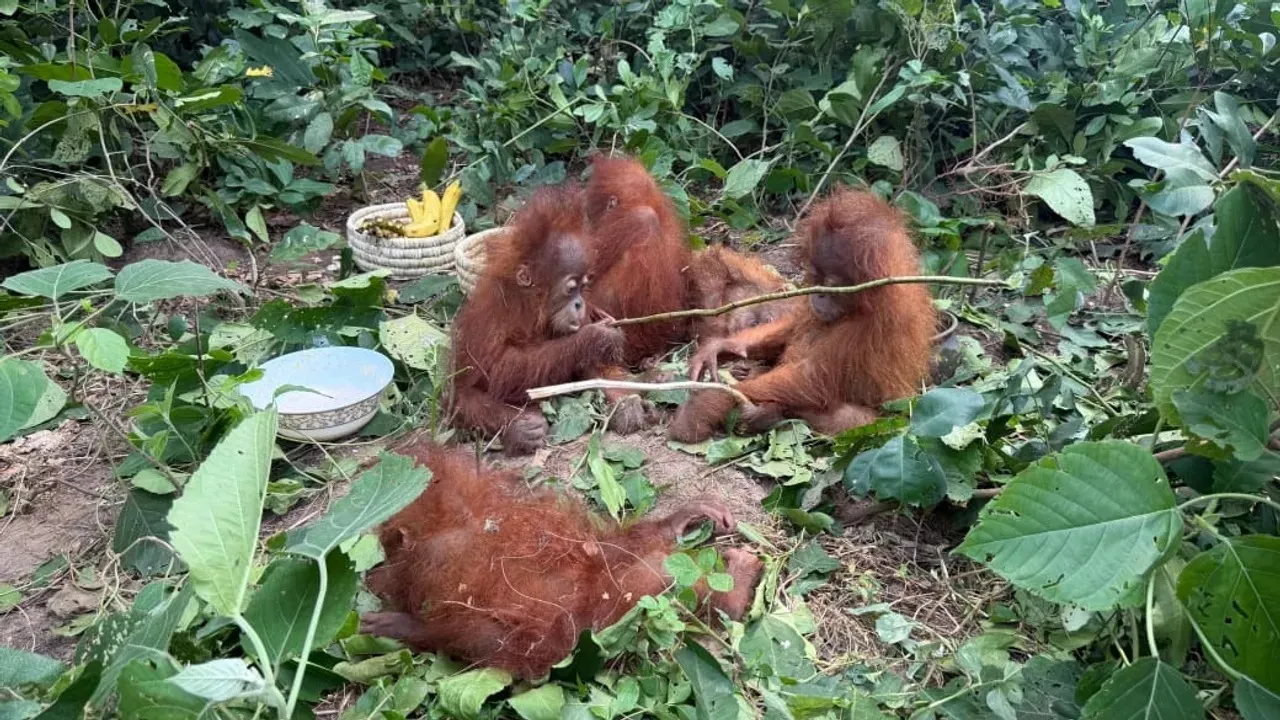
Baleshwar: In a rare and unusual wildlife sighting, five orangutans have been spotted in the Bichitrapur forest area under Bhograi block of Odisha’s Baleshwar district, triggering concern among forest officials and raising questions over how the animals reached the state.
Orangutans are not native to India and are naturally found only in the tropical rainforests of Borneo and Sumatra in Southeast Asia. The discovery of five of the critically endangered great apes in a rural forest in Baleshwar has therefore prompted the Odisha Forest Department’s wildlife wing to launch an investigation into their origin and possible route into the state.
According to forest officials, a team from the Udayapur Forest Division spotted the animals near Barapahi during routine patrolling in the Rankotha area on Tuesday morning. Senior officials were immediately informed, following which a special team was formed to track and safely rescue the orangutans.
The orangutans were subsequently rescued and taken for veterinary examination. A team from Nandankanan Zoological Park in Bhubaneswar, comprising veterinary doctors and wildlife experts, has reached Bhograi to assist in assessing the animals and their condition.
Odisha Forest and Environment Minister Ganesh Ram Singh Khuntia said an international mafia link could not be ruled out in connection with the presence of the orangutans in Baleshwar district.
According to the Minister, one orangutan can reportedly fetch around Rs 25 lakh in the market, raising concerns about possible illegal wildlife trafficking. He said orangutans are found in regions including Malaysia, Sumatra, Indonesia and China, while there is no such native species in Indian forests.
The Minister said the investigation would establish where the animals were being transported from and how they reached Odisha. “An international mafia link may be involved. The investigation will make it clear from where the orangutans were being transported and how they reached Odisha,” Khuntia said.
The five orangutans are currently being kept under quarantine and are receiving medical attention from veterinarians. Following their treatment and health assessment, they are expected to be shifted to Nandankanan Zoological Park in Bhubaneswar.
Principal Chief Conservator of Forests (Wildlife) and Chief Wildlife Warden (CWLW) Prem Kumar Jha had earlier said that the health of all five orangutans would be thoroughly examined. The Forest Department will also investigate their origin and the circumstances under which they arrived in Baleshwar.
Officials have also informed the local police about the unusual discovery. Given the fact that orangutans are not indigenous to India, authorities are examining the possibility of an illegal wildlife trade or an international smuggling network being involved.
The animals are expected to be shifted to Nandankanan Zoological Park in Bhubaneswar after the necessary procedures. Once brought to the zoo, they will be kept under quarantine and monitored closely by veterinary and wildlife experts.
The Forest Department also plans to conduct research on the rescued orangutans to gather more information about the species and their condition.
The discovery has attracted considerable attention from local residents, with crowds gathering in the forest to catch a glimpse of the rare animals. However, authorities have urged people to maintain a safe distance and avoid disturbing the orangutans during the rescue and examination process.
Orangutans are among the closest living relatives of humans and are known for their remarkable intelligence and adaptability. They are largely fruit-eaters but also consume leaves, bark, insects and bird eggs. Unlike many other great apes, adult orangutans generally live solitary lives. Female orangutans maintain strong bonds with their young and care for them for several years before they become independent. The animals also build fresh nests from branches and leaves in trees each night.
The species is classified as Critically Endangered, with habitat destruction, deforestation, illegal hunting and the expansion of palm oil plantations among the major threats to their survival.
The unusual presence of five orangutans in Baleshwar has consequently become both a wildlife conservation concern and a potential wildlife trafficking case. The ongoing investigation is expected to determine their origin, route into Odisha and whether an organised illegal trade network was involved.

Comments are closed.