


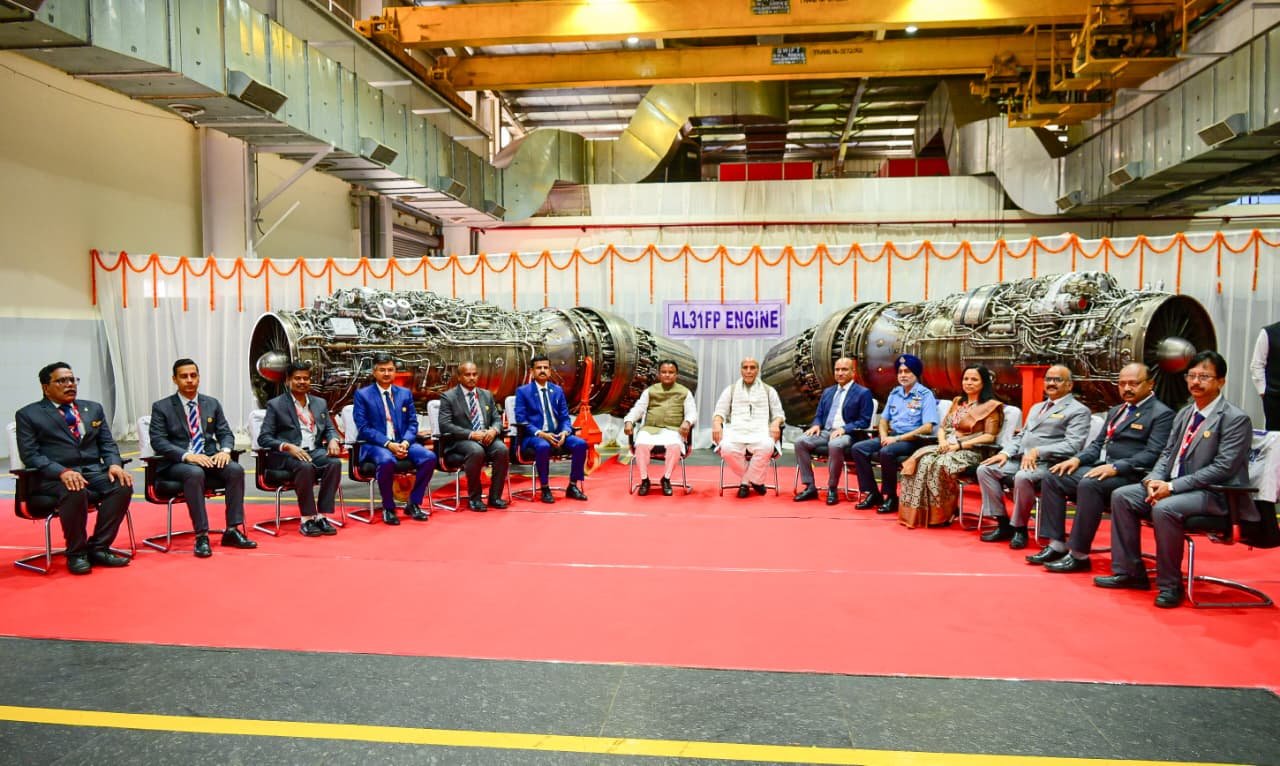
Bhubaneswar: Defence Minister Rajnath Singh on Tuesday lauded Hindustan Aeronautics Limited’s (HAL) Koraput division for its contribution to India’s aerospace and defence capabilities, stressing the need for indigenous aero-engine technology to achieve greater self-reliance.
Singh visited the HAL facility at Sunabeda in Koraput district, where he attended a special programme marking the delivery of the division’s 2,000th aero-engine and the launch of a second manufacturing line for the Shakti engine. Odisha Chief Minister Mohan Charan Majhi also attended the programme.
The Shakti engine production programme is being established at an estimated cost of Rs 218 crore. The turboshaft engine, which powers Indian military helicopters, has been developed through collaboration between HAL and France-based Safran Helicopter Engines.
Addressing the gathering, Mr Singh said the delivery of 2,000 engines represented thousands of contributions to the operational capability of the Armed Forces and reflected the dedication of generations of engineers, scientists, technicians and skilled workers.
He noted that HAL Koraput had manufactured engines for frontline aircraft, including the MiG-21, MiG-27, MiG-29 and Su-30MKI. The facility has also overhauled more than 9,000 engines, highlighting its critical role in maintaining the operational readiness of the Armed Forces.
The Defence Minister said aero-engine technology was among the most complex areas of modern engineering, requiring advanced metallurgy, precision manufacturing, testing, cooling technologies and stringent quality assurance.
He particularly underlined the need to develop indigenous high-thrust engine capability for the Advanced Medium Combat Aircraft (AMCA), saying this would be crucial for complete indigenisation of the fighter aircraft.
“A critical component of the Advanced Medium Combat Aircraft (AMCA) is its high-thrust engine. To completely indigenise AMCA, the technical know-how being developed by our engineers here will prove highly effective,” Mr Singh said.
He said the proposed investment of about Rs 5,000 crore, efforts to indigenise raw materials in collaboration with MIDHANI and the establishment of India’s first indigenous high-thrust engine testing facility were significant steps towards achieving self-reliance in aerospace technology.

Comments are closed.