


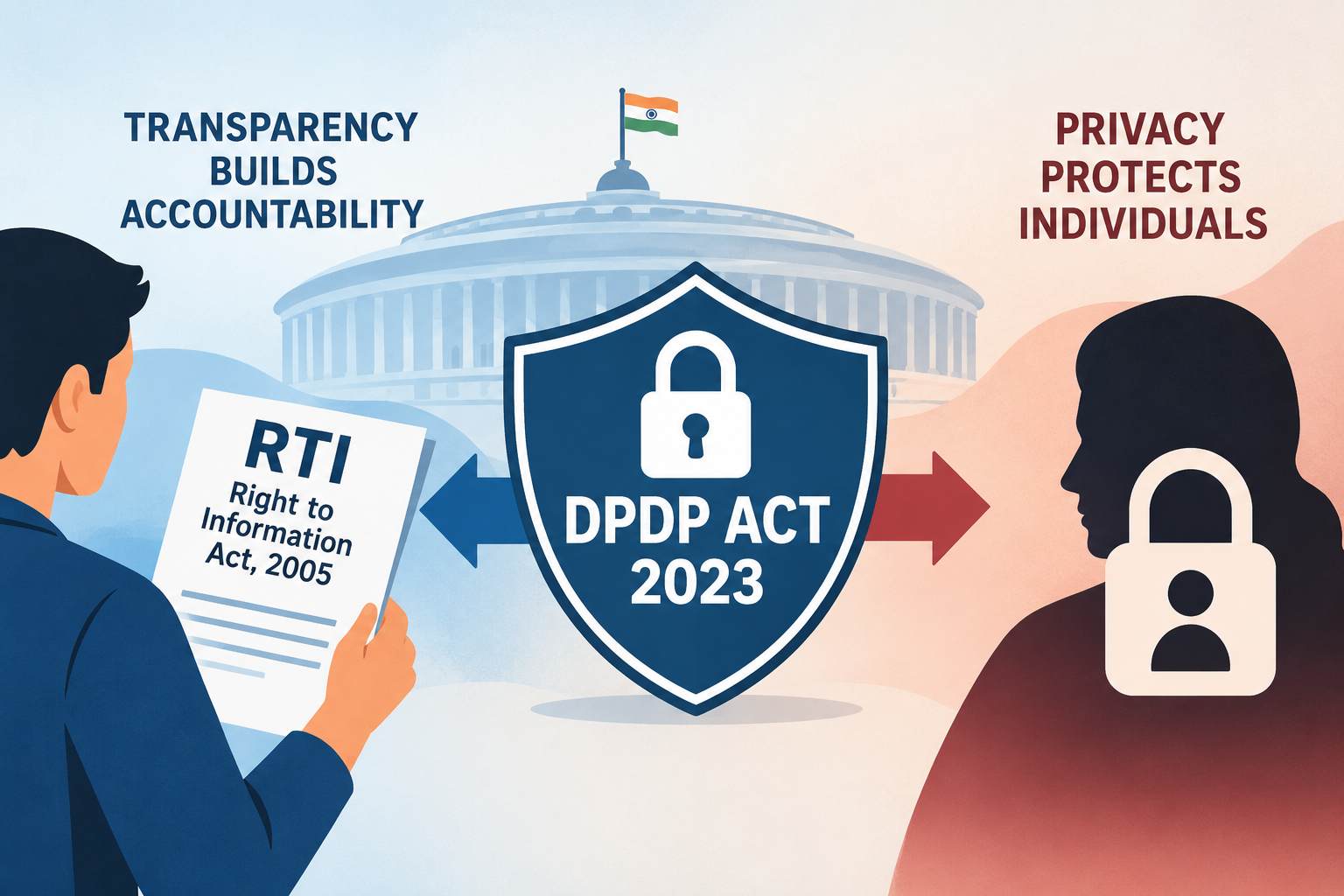
THE amendment to the RTI Act through the Digital Personal Data Protection Act-2023 (DPDP) has triggered serious concerns over transparency, accountability and citizens’ right to know. Protecting personal privacy is essential, but it must not become a convenient shield for government secrecy.
India’s Right to Information (RTI) Act-2005 was enacted to empower citizens to question those in power, expose corruption and ensure accountability in public administration. Nearly two decades later, this landmark transparency law faces a significant challenge from an amendment introduced through the DPDP.
At the centre of the controversy is Section 44(3) of the DPDP Act, which amends Section 8(1)(j) of the RTI Act. The earlier provision allowed public authorities to withhold personal information if its disclosure had no relationship with public activity or interest, or would cause an unwarranted invasion of privacy. However, it also provided scope for disclosure where larger public interest justified it.
The amended provision replaces this detailed safeguard with a broader exemption covering information relating to personal information. The change has raised concerns that government departments could use privacy as a blanket justification to reject legitimate RTI applications.
The implications could be far-reaching. Information relating to government appointments, public officials’ qualifications, beneficiaries of welfare schemes, recruitment irregularities, public contracts and alleged financial misconduct may involve personal details. If such information is routinely classified as private, citizens and journalists could find it increasingly difficult to investigate wrongdoing and expose administrative failures.
This does not mean that individual privacy should be sacrificed in the name of transparency. Citizens have a legitimate right to protect their personal data from misuse, unauthorised disclosure and commercial exploitation. However, privacy and transparency are not mutually exclusive. A democratic system must protect both through a fair and proportionate legal framework.
The government maintains that Section 8(2) of the RTI Act, which permits disclosure where larger public interest outweighs the harm to protected interests, continues to operate. However, the absence of an explicit public-interest safeguard in the amended Section 8(1)(j) creates uncertainty over how consistently this protection will be applied by Public Information Officers and appellate authorities.
The controversy has now reached the Supreme Court, where petitions challenging the constitutional validity of the amendments are pending. The Court will have to examine whether the changes strike a constitutionally acceptable balance between privacy and the fundamental right to information.
Ultimately, data protection must not become a tool for protecting those in power from public scrutiny. The strength of a democracy lies not merely in protecting the privacy of its citizens but also in ensuring that its government remains answerable to them.
India needs a data protection framework that safeguards personal information without weakening the people’s right to question authority. Privacy is a fundamental right, but so is the citizen’s right to know. Neither should become a casualty of the other.

Comments are closed.