


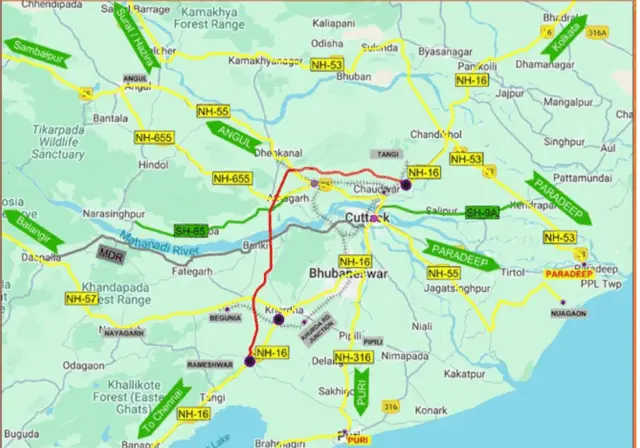
Bhubaneswar: The National Highways Authority of India (NHAI) has issued a Letter of Award (LOA) for the construction of a six-lane access-controlled Greenfield Capital Region Ring Road, known as Bhubaneswar Bypass project, in Odisha.
The project involves the development of a 111 km long Ring Road from Rameshwar to Tangi in three packages under the Hybrid Annuity Mode (HAM). The project is expected to be completed in about 30 months from the date of commencement, an official statement said on Tuesday.
Package–I of the project has been awarded to Patel Infrastructure Limited for the construction of a 40 km long six-lane section with paved shoulders from Rameshwar to Bilipada. The project also includes the development of a 12.4 km long service road on each side, two interchanges, one ROB, 10 minor bridges, 142 culverts, one wayside amenity, seven elevated underpasses, and eight VUPs, LVUPs, and SVUPs.
Package–II of the project has been awarded to VRC Constructions (India) Limited for the construction of a 30 km long six-lane section with paved shoulders from Bilipada to Gobindpur. The project also includes the development of a 7.2 km long service road on each side, three interchanges, 11 minor bridges, 90 culverts, one wayside amenity, three elevated underpasses, three VUPs, six LVUPs, and three SVUPs.
Package–III of the project has been awarded to HG Infra Engineering Limited for the construction of a 40 km long six-lane section with paved shoulders from Gobindpur to Tangi near Bandola Toll Plaza. The project also includes the development of a 10 km long service/slip road on each side, one interchange, 23 minor bridges, 69 culverts, one wayside amenity, two elevated underpasses, six VUPs, 16 LVUPs, and three SVUPs.
With a design speed of 100 kmph, the Capital Region Ring Road (Bhubaneswar Bypass) is envisaged to significantly enhance regional connectivity and mobility by decongesting the urban areas of Bhubaneswar, Cuttack, and Khurda.
The access-controlled corridor will boost regional connectivity, lower logistics costs, generate substantial employment, and support long-term economic growth while promoting safer, faster, and more sustainable travel across the region.

Comments are closed.