


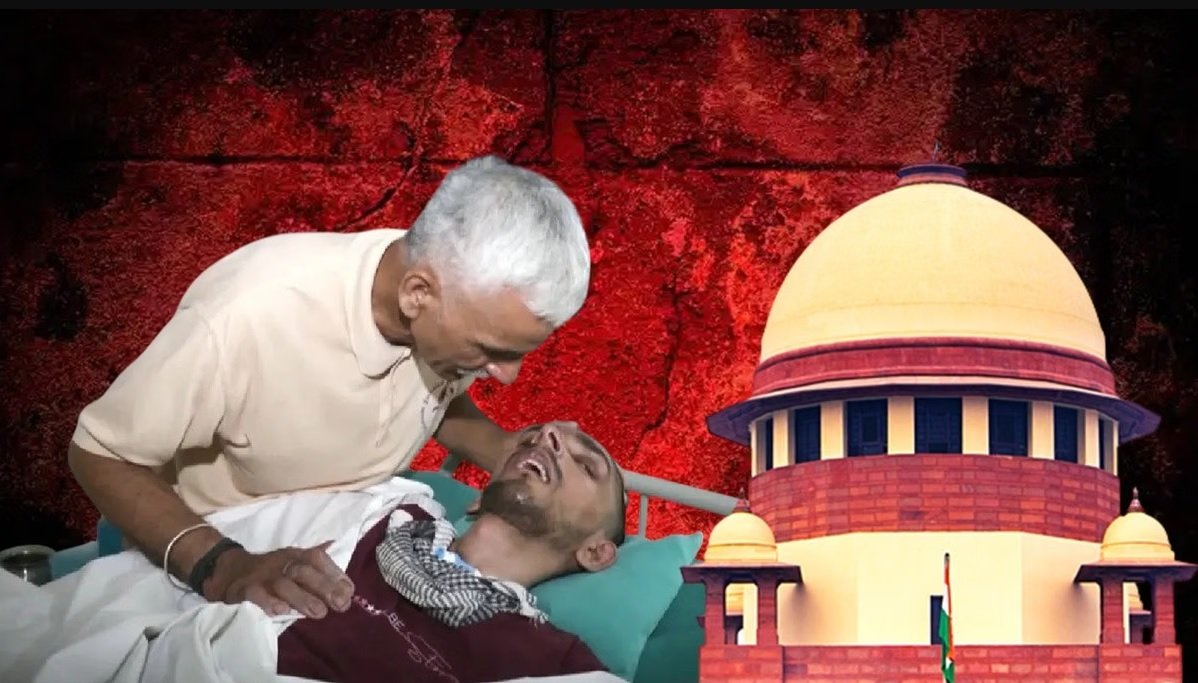
FOR 13 years, Ashok Rana and his wife have lived with a mix of hope and heartbreak. Their son, Harish Rana, was a college student in 2012 when he fell from the fourth floor, leaving him with severe brain injuries. Since then, he has remained in a vegetative state, with his parents standing by his side for more than a decade.
Feeding him through tubes, caring for him every day, waiting… hoping… and praying that one day, he might wake up. But that day never came. Now, at 32-year-old, Harish has been admitted to AIIMS New Delhi, where doctors will carry out India’s first court-approved passive euthanasia after the Supreme Court granted permission. A medical team will gently withdraw the life-support systems that have kept him alive for years. From that moment, his body will continue only for as long as it naturally can.
Even in this moment of unimaginable grief, the family has chosen compassion. They have expressed their wish to donate Harish’s organs, so that other lives may continue. But beyond the legal judgment and medical procedure, lies a story of parents who spent 13 years fighting for their child, only to one day stand before a court and ask permission to let him go. There may be no pain greater than that.
Sometimes love means holding on. And sometimes, after years of suffering, love means finding the strength to say, “Rest now, my child.”
“It’s time to go now, okay?” – In the quiet lanes of Ghaziabad, Harish Rana’s family gathered around his bed on which he lay motionless, saying their final goodbye shortly before he was taken to AIIMS Delhi on Saturday, where doctors are gradually withdrawing his life support.
A 22-second heart-wrenching video has surfaced showing Rana’s family spending their last moments with him. His mother sat close to him, with her face etched with devastation. A Brahma Kumaris sister was seen applying ‘tilak‘ on his forehead. “Forgive everyone, apologise to everyone. It’s time to go now, okay?” she told him while stroking his head.
The Rana family has links to the Brahma Kumaris – a social-cultural organisation which helped them find a lawyer to fight for Harish’s euthanasia.
What is passive euthanasia?
The word “euthanasia” is derived from the Greek words “eu” and “thanatos”, which literally mean “good death.” It is commonly described as mercy killing. Passive euthanasia is the legal, ethical practice of withdrawing or withholding life-sustaining medical treatment (like ventilators or feeding tubes) from a terminally ill or irreversibly comatose patient, allowing death to occur naturally. It differs from active euthanasia, which involves direct action to end life. It is permitted in India under strict safeguards, recognized in the landmark Aruna Shanbaug case (2011) and reaffirmed by Common Cause v. Union of India (2018). It can be voluntary (with consent) or non-voluntary (without consent, often when the patient is in a coma).
In the landmark judgment of Harish Rana v. Union of India & Ors. (2026), the Supreme Court fundamentally reshaped the legal and ethical landscape of end-of-life care. By authorizing the withdrawal of life-sustaining treatment for Harish, the Court transitioned passive euthanasia from a theoretical constitutional right into a practical reality.
The Jurisprudential Journey
The path to the Harish Rana judgment was paved by decades of legal deliberation. For years, the legal stance was defined by Gian Kaur v. State of Punjab (1996), where the Supreme Court held that the “right to life” under Article 21 did not include a “right to die,” emphasizing the preservation of life.
However, the 196th Law Commission Report (2006) began to distinguish between “mercy killing” and the “withdrawal of life support”. It argued that refusing medical treatment that merely prolongs the process of dying is a “lawful omission”. This philosophy was later echoed in the 241st Law Commission Report (2012), which supported passive euthanasia on humanitarian grounds and to protect doctors acting in a patient’s best interest.
The watershed moment arrived with Aruna Ramachandra Shanbaug v. Union of India (2011), where the Court officially recognized passive euthanasia as legal under strict judicial supervision. This was further solidified by the 2018 Common Cause Constitution Bench, which declared that the “right to die with dignity” is an inseparable facet of the right to life under Article 21.
In light of the aforementioned authorities, it is clear that while India prohibits active euthanasia, it has legalized passive euthanasia under specific conditions. Although the deliberate administration of lethal substances remains illegal, the Supreme Court has ruled that life-sustaining treatment may be withdrawn or withheld for patients in a permanent vegetative state.
Author is a journalist, media educator and researcher. Views are personal.

Comments are closed, but trackbacks and pingbacks are open.