


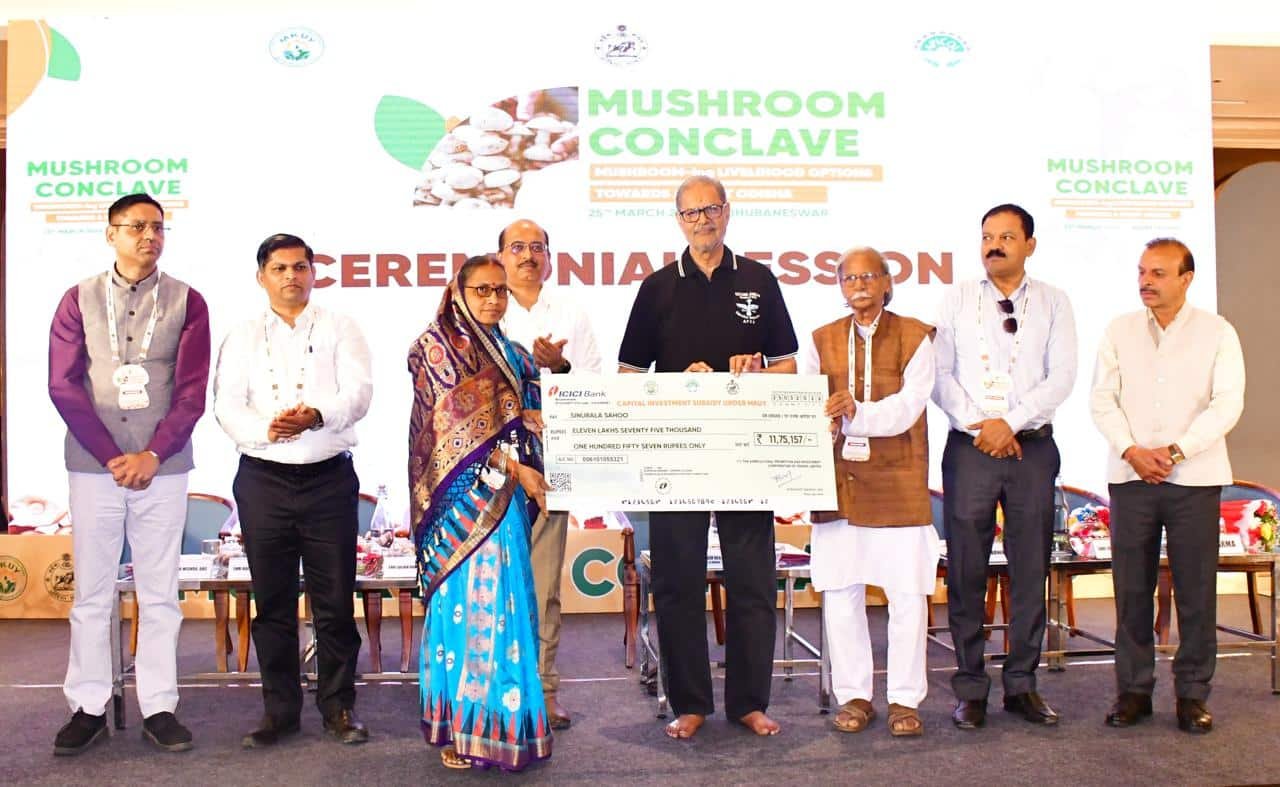
Bhubaneswar: Deputy Chief Minister Kanak Vardhan Singh Deo on Wednesday graced the closing ceremony of the Mushroom Conclave 2026 organised by the Agricultural Promotion and Investment Corporation of Odisha Limited (APICOL) under the Department of Agriculture & Farmers’ Empowerment (DA&FE) at a private hotel here.
Underscoring the the state’s rising prominence in the national mushroom landscape, he said, “Odisha is now one of the leading states in mushroom production, contributing 11% of the country’s total output.” He described mushrooms as a “superfood” — nutrient-rich, fat-free, low in cholesterol, and environmentally sustainable owing to their organic cultivation methods and low water requirement.
The Deputy Chief Minister highlighted various government initiatives, including subsidies under the Mukhyamantri Krishi Udyog Yojana (MKUY), development of market linkages, and robust logistic support to boost the sector. He also launched a new website of APICOL and distributed “Go-Ahead” letters to selected mushroom producers for setting up production and spawn units.
Held under the theme “Mushrooming Livelihood Options towards a Viksit Odisha”, the event brought together over 170 participants, including progressive farmers, members of the Odisha Mushroom Growers Federation, scientists from OUAT, and agri-entrepreneurs.
Commissioner-cum-Secretary, DA&FE, Sachin Ramchandra Jadhav, emphasised the quick returns and profitability of mushroom cultivation. “It offers easy income in a short-duration cycle and consumes significantly less water compared to traditional crops or vegetables,” he noted.
Other dignitaries who addressed the gathering included Director of Soil Conservation & Watershed Development Subrat Kumar Panda, Director of Horticulture Kalunge Gorakh Waman, Vice-Chancellor of OUAT Dr Pravat Kumar Roul, Dr. V P Sharma, Managing Director of APICOL Subhransu Mishra, and Prof. (Dr.) Adwaita Kumar Patra, Chairman of the Odisha Mushroom Growers Federation.
The conclave featured nine technical sessions by expert speakers covering advanced production techniques, post-harvest management, value addition, and market linkages for mushrooms. Special focus was given to paddy straw, oyster, and button mushrooms.
Officials informed that so far, 1,207 farmers have received approval for setting up mushroom-based enterprises, including spawn production, cultivation, and processing units. Additionally, 207 entrepreneurs have already availed subsidies to establish their ventures, signalling strong momentum in the sector.
The event reinforced the state government’s vision of building a robust, market-driven mushroom ecosystem that can significantly enhance rural incomes and contribute to the goal of a developed Odisha by 2036.
With its favourable climate, rising domestic demand, and policy support, mushroom cultivation is fast emerging as a promising avenue for agri-entrepreneurship and women-led enterprises across the state.

Comments are closed, but trackbacks and pingbacks are open.