


Heritage lovers explore Grameswar temple, centenarian primary school in Jagatsinghpur

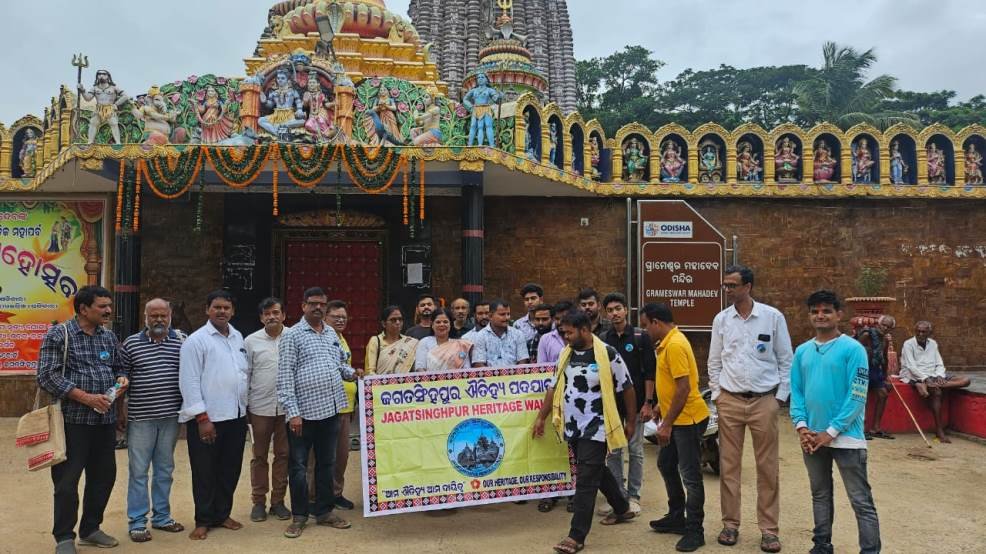
Jagatsinghpur: The 6th edition of the Jagatsinghpur Heritage Walks (JHW) yesterday explored Grameswar Temple at Panchapalli village, in which around 40 participants from across Odisha participated.
The connotation of village Panchapalli represents five hamlets such as Gobindapur, Patana,Paniendula, Naradia and Tikarapara. Five village goddesses representing these hamlets always evoke a religious sanctity for the region.
Shree Grameswar Mahadev’s abode, built on the bank of the Hansua river, has got its mention in the Vedic text, popularly known as Garga “Peetha”. The history relating to the origin of Shree Grameswar Mahadev is very interesting and eventual. As mythology and folklore narrate, the ruler of Bishunpur had constructed the temple basing on the account of a cow boy.
He found that the cow was regularly stationed at certain point and oozing out the milk. The cow boy reported this unusual incident to the king. The king in return ordered for excavation.
During the process of digging there appeared a “lingam” of Lord Mahadev. The King tried to fathom its root, but in vain. The “lingam” appeared in the midst of village (grama) for which the king named it as “Grameswar Mahadev”.
After emergence of the Shiva “lingam” the king constructed a permanent wooden and thatched house and engaged Brahmins from Kanyakubja for performing puja and observing the rituals of Lord Shiva. Another story referring to the Puranic texts says “Sage Garga, the son of Lord Brahma, installed this “lingam” to offer puja. After the demise of Sage Garga the “lingam” was buried under the earth and the cow was oozing her milk at that place. On the basis of Puranic reference the place of Lord Shiva at Panchapalli is also called “Garga Peetha”. A small temple of Sage Garga located on the temple premises of Grameswar Mahadev stands as a testimony to it.
After the death of the king of Bishunpur the landlords of the regions took the responsibility of worshiping Lord Shiva. Subsequently, the Endowment Commission, taking the responsibility of the management of the temple, formed a trust. In the passage of time the old temple of wooden and thatched cover was removed, temple of 71 feet height has been constructed by the Trust with active support of locals.
The beautiful sculptures on the temple wall of Shree Grameswar Mahadev, and different festivals have been attracting devotees from Odisha and outside. Apart from Lord Shiva Lord Jagannath, Balabhadra and Subhadra are also worshiped here at the Nrusinghnath temple.
The heritage enthusiasts also visited a 100-year-old primary school that just celebrated its Centenary. They were welcomed by headmistress Laxmipriya Swain and retired headmaster Shuva Narayan Nayak. Convenor of Cuttack Heritage Walks Dipak Samantarai addressed the children about heritage conservation. Pravanshu Samantaray of Dibyaduta publication also interacted with children and distributed Odia story books. Biswaranjan Dehury of Odisha Heritage Walks thanked the villagers and participants.
Earlier, at the Grameswar Temple JHW convener Srikanta Singh welcomed the temple trust committee and villagers led by Sishir Kumar Biswal and Jivananda Mishra of Vidyapuri Publication.

Comments are closed.