


Bhubaneswar: Healthcare services across Odisha faced significant disruption on Wednesday as government doctors, under the banner of the Odisha Medical Services Association (OMSA), began an indefinite strike, coinciding with National Doctors’ Day.
According to sources, the cease-work agitation has severely affected outpatient departments (OPD), routine care, and other services in many state-run hospitals, particularly in district and rural facilities.
The strike was triggered by the government’s prolonged failure to address a 10-point demand list, despite more than three years of repeated appeals. The OMSA stated that the association had no choice but to proceed after eleventh-hour talks on Tuesday night yielded only verbal assurances, which the doctors said they could not trust.
An emergency meeting of the OMSA Action Committee on Tuesday reaffirmed the decision to strike, with President Kishor Mishra and General Secretary Sanjib Pradhan noting that a government-appointed resolution committee had failed to convene. Doctors have placed full responsibility for any inconvenience to patients on the state administration’s inaction.
The association has called upon all sections of its cadre — Odisha Medical and Health Services doctors, Odisha Medical Service dental surgeons, contractual medical officers, doctors deputed to medical colleges and postgraduate students — to participate in the agitation, demanding cadre restructuring with Dynamic Assured Career Progression (DACP) to fix promotion delays, resolution of pay scale anomalies (particularly arbitrary structures under Level 15 of the pay matrix), a transparent and merit-based transfer policy, enhanced safety measures against workplace violence, and comprehensive health insurance coverage for government doctors.
One OMSA representative from Baleshwar highlighted that the district is functioning with roughly 300 doctors against a sanctioned strength of 600, placing unsustainable pressure on existing staff and compromising both doctor well-being and patient safety.
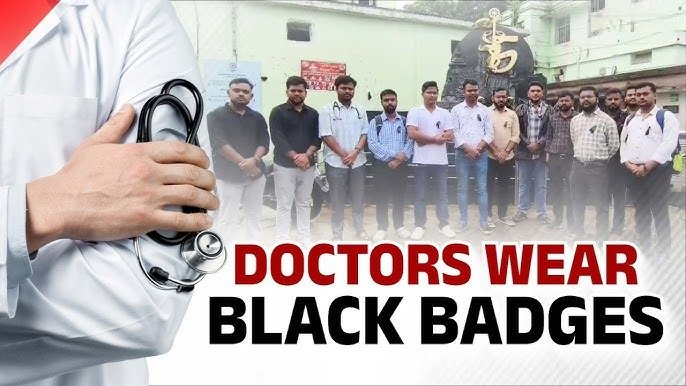
The association had earlier held black-badge protests and issued an ultimatum for resolution by July 1. Doctors recalled that similar verbal assurances were given by the Health Minister and Health Secretary during a token strike in January, but no concrete orders followed in the subsequent months.
Major tertiary institutions, such as SCB Medical College and Hospital in Cuttack and Capital Hospital in Bhubaneswar, managed to maintain services as senior faculty, assistant professors, and medical students stepped in to manage the patient load. However, district headquarters hospitals, sub-divisional facilities, Primary Health Centres (PHCs), and Community Health Centres (CHCs) in outlying areas experienced a near-total shutdown of routine care.
In a show of solidarity, the SCB Medical College Junior Doctors’ Association (JDA) has extended its support. They wore black badges while on duty, warning of further escalation if the government fails to act.
OMSA has strictly cautioned the administration against taking punitive action against striking doctors. The association warned that any retaliatory measures would trigger an immediate escalation, beginning with protests outside local police stations and SP offices, and culminating in a statewide “Jail Bharo” agitation.
Doctors have urged the Chief Minister, the Health Minister, and Health Secretary to intervene swiftly with written commitments to restore normalcy and prevent prolonged hardship, especially for patients from remote areas who rely on public facilities.

Comments are closed.