


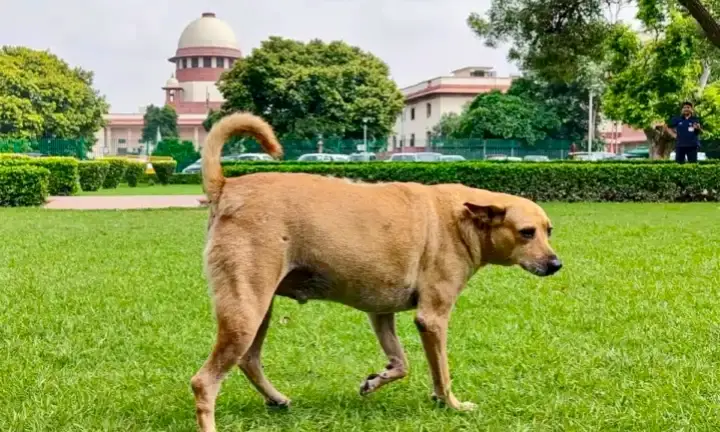
New Delhi: The Supreme Court, on Wednesday, resumed hearing of its suo motu case on stray dogs and observed that “prevention is better than cure” as it is impossible to predict an animal’s behaviour.
The bench of Justice Vikram Nath, Justice Sandeep Mehta and Justice N V Anjaria had on November 7, 2025, directed state governments and the National Highways Authority of India (NHAI) to ensure the removal of stray dogs from highways across the country.
It had also directed all educational and healthcare institutions, both government and private, to erect fences within 8 weeks to tackle the stray dog threat and prevent dog bites.
Several parties furnished their arguments in the case during the day’s hearing that concluded a little after 1 pm, and is slated to resume at 10.30 am on Thursday.
As the hearing continued, the Court remarked that it was impossible to predict an animal’s behaviour or know whether a dog is in a “mood to bite”, asserting that in matters of public safety, “prevention is better than cure”, as reported by Mint.
The Court also noted that only about 10 states had filed compliance affidavits regarding the implementation of Animal Birth Control Rules and the building of shelter infrastructure, indicating a lack of urgency.
It reiterated its concern over “systemic failure” to secure sensitive public places, such as schools, hospitals, and railway stations, from the stray dog threat. The bench referred to its November 7 direction that stray dogs must be removed from these places for safety, and not released back in these locations.
Senior advocate K K Venugopal highlighting the challenges involved in sending all stray dogs to shelters.
There are approximately 5.25 crore stray dogs in India, he said, adding that housing them would require 77,000 shelters. Feeding, meanwhile, would cost an astronomical Rs 62 crore daily, he submitted, illustrating the sheer scale of the challenge.
Senior advocate Kapil Sibal called for distinguishing between street dogs and dogs found in institutional areas, referring to the latter as “community dogs” who should be managed under Animal Birth Control Rules rather than being removed permanently.
He also questioned the feasibility of feeding dogs under current laws, asking who would bear the astronomical costs and the logistical requirements, arguing against mass institutionalization.
Senior advocate Colin Gonsalves, representing NGOs in the present case, argued that dog bite statistics were “grossly inflated”, and claimed that authorities often count every rabies shot as a separate dog bite case, essentially meaning that a single incident could be counted as 5-7 separate cases.
The Court, meanwhile, questioned the NHAI and flagged serious concerns regarding stray animals (both dogs and cattle) on India’s highways, citing recent accidents and seeking an explanation from the NHAI and states to barricade roads.
The Apex Court also expressed its astonishment at the volume of pleas it had received pertaining to the present case, and noted: “So many applications normally don’t even come in cases of humans.”

Comments are closed, but trackbacks and pingbacks are open.