


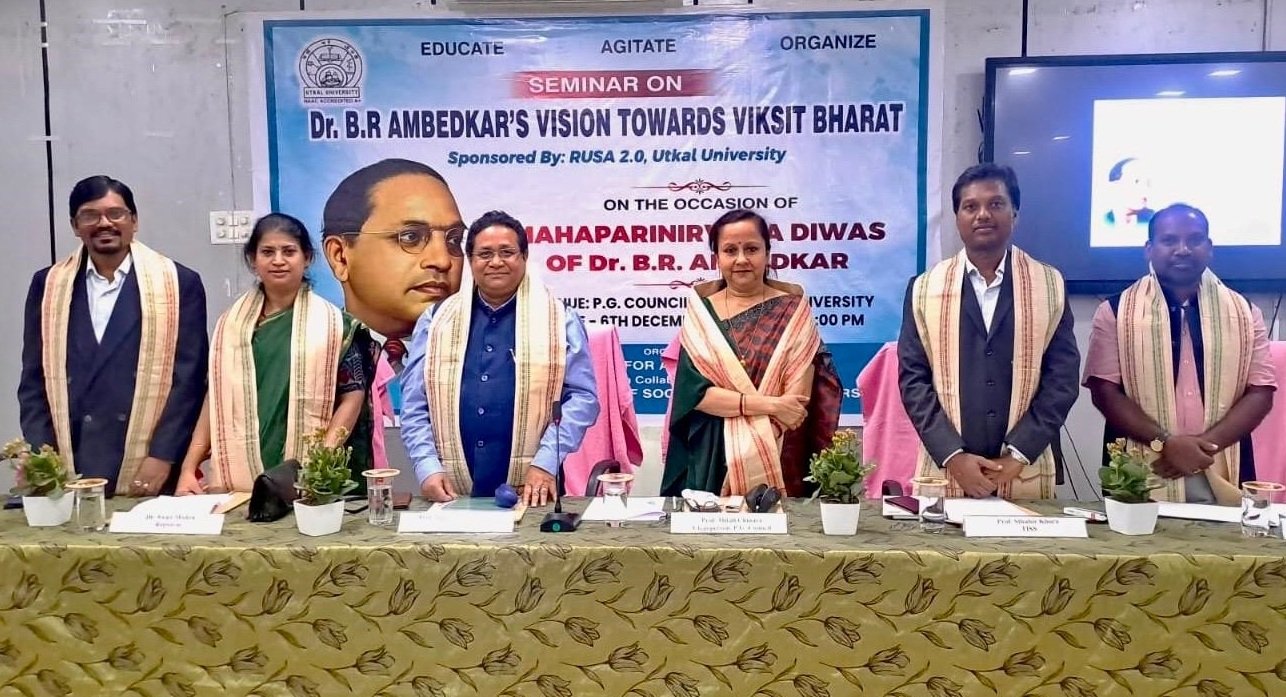
Bhubaneswar: A seminar titled ‘Dr. B. R. Ambedkar’s Vision towards Viksit Bharat’ was organised by the Centre for Ambedkar Studies, Utkal University as part of Mahaparinirvan Divas of Dr. B. R. Ambedkar here on Saturday. The aim of seminar was to reflect on Ambedkar’s transformative ideas and their continuing relevance for building a developed and inclusive India.
In his welcome address, Vice-Chancellor Prof. Jagneshwar Dandapat highlighted Ambedkar’s vision for Viksit Bharat, emphasising economic modernisation through industrialisation, land reforms, and social equality as essential foundations for a developed India by 2047. He further noted that Ambedkar’s ideas on agriculture, industry, fiscal policy, and economic democracy continue to shape the nation’s developmental discourse and remain central to constructing a truly Viksit Bharat.
Speaking on the occasion, Chairperson of P.G. Council Dr. Mitali Chinara elaborated Ambedkar as a tireless advocate of education as the pathway to dignity, citizenship, and national progress. She reaffirmed that as India strives toward Viksit Bharat 2047, Ambedkar’s educational philosophy continues to guide the nation towards equality, innovation, and collective upliftment.
Joining as Guest of Honour, Registrar Dr. Swati Mishra highlighted the national vision of Viksit Bharat 2047 and revisited Ambedkar’s feminist, constitutional, and socio-economic ideals for inclusive development. She emphasised that Ambedkar’s vision for women’s empowerment remains central to realising a truly developed Bharat.
Presenting a keynote address on the topic, former Dean of TISS, Mumbai Prof. Sthabir Khora focused on Ambedkar’s vision for a just, equitable, and progressive nation. He discussed Ambedkar’s concept of social endosmosis, where every individual enjoys freedom of opportunity without direct or indirect discrimination. He argued that Ambedkar’s roadmap for Viksit Bharat is grounded in constitutional morality, democratic ethics, and pragmatic governance.
Director of Centre for Ambedkar Studies Prof. Rabindra Garada welcomed the guests and highlighted Ambedkar’s emphasis on the decisive role of educated, skilled, and socially conscious youth in shaping India’s future. He stressed the importance of inclusive growth, ensuring the development of all sections of society, strengthening women’s empowerment across all spheres of life, and advancing rural prosperity through adequate land reforms and agricultural development.
Dr. Iswar Chandra Naik delivered a scholarly deliberation on Ambedkar’s contributions to the development of tribal society through the effective implementation of constitutional provisions. He highlighted the significance of the Fifth and Sixth Schedules, along with various constitutional articles, and explained Ambedkar’s vision of a classless, casteless, and egalitarian society founded on liberty, equality, fraternity, and social justice.
The programme also included prize distribution for the debate competition winners and the felicitation of guests. The seminar concluded with a formal vote of thanks by Dr. Paramananda Naik, Deputy Director of Centre for Ambedkar Studies. Dr. Sumitra Murmu moderated the session.

Comments are closed, but trackbacks and pingbacks are open.