


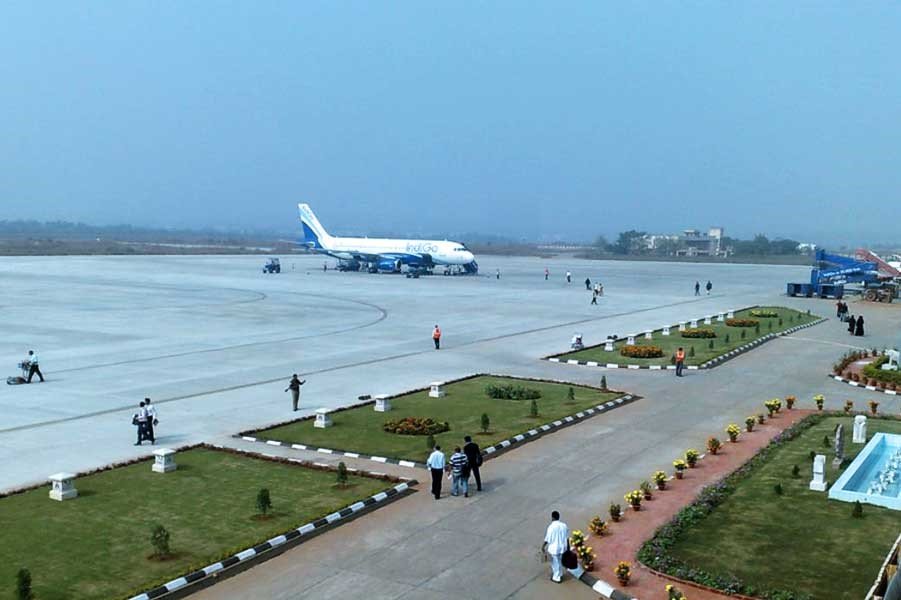
Bhubaneswar: The Airports Authority of India (AAI) has taken a significant step toward expanding Bhubaneswar’s Biju Patnaik International Airport (BPIA) by submitting a proposal exceeding Rs 1,200 crore to the Union Finance Ministry’s Public Investment Board (PIB) for the approval of Terminal 3 (T3).
Once cleared by the board, the airport will float tenders to initiate the ambitious expansion, which will be constructed over a 65,000-square-meter plot located inside the operational area near the existing Terminal 1 (T1) building.
Designed as a two-and-a-half-storey integrated structure, the new terminal aims to unify both domestic and international arrivals and departures under a single roof, dramatically upgrading the airport’s footfall capacity to 8.6 million passengers annually. “Before floating the tender, a multi-stakeholder meeting will be organised to discuss the design, size and pattern of the new terminal. But in any case it will be a two-and-half-storey terminal. The expansion will enhance passenger convenience and operational efficiency,” an airport officer said.
Incorporating modern architecture while reflecting local aesthetics, the officer added that “the design of the terminal will have a touch of Odisha’s heritage and culture and it may reflect Odisha’s temple architecture as well.”
The project comes as a response to rising air traffic, passenger comfort requirements, and growing commercial demands in the region. To accommodate the expanded operations, BPIA, which currently features 18 aircraft aprons, will require six additional aerobridges once T3 is functional. “Work on the terminal building will start once the tender process is over. Multiple parties, based on their expertise, may be involved in the project,” airport officials added.
The airport originally functioned with a single old domestic terminal, which was converted into the current international terminal (T2) in March 2013 with dedicated customs and immigration facilities. Shortly after, a state-of-the-art modular domestic terminal (T1) was built at a cost of Rs 145 crore to handle around 1,000 peak-hour passengers while allowing future scaling. The upcoming integrated T3 building is set to replace these standalone operations, streamlining international and domestic travel into a single, high-capacity hub.

Comments are closed.