


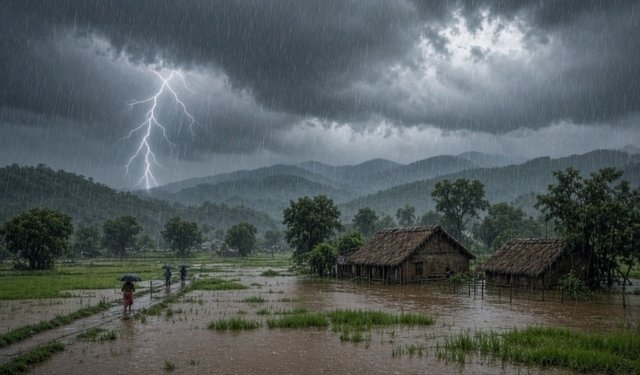
Bhubaneswar:Odisha has faced severe waterlogging and weather disruptions this year, experiencing heavy rainfall across both the monsoon and post-monsoon periods despite active El Niño conditions, according to the India Meteorological Department (IMD).
The season began with a sharp setback. Following a delayed monsoon onset linked to El Niño, Odisha recorded a 47% rainfall deficit in June. However, from July onward, recurring cyclonic circulations and low-pressure systems over the Bay of Bengal triggered prolonged spells of rain, turning the season into a major surplus. Typically, El Niño years such as 2015 or 2023 are associated with weaker monsoons and drought-like stress in the state, making this year’s pattern a sharp departure from the norm.
Data shared by Dr Manorama Mohanty, Director of the Regional Meteorological Centre in Bhubaneswar, shows that Odisha recorded 1,484.3 mm of rainfall during the June–September monsoon window—29% above normal—even though levels around 1,150.2 mm are more commonly associated with La Niña years. Following the monsoon withdrawal in October and November, rainfall jumped to more than 45% above normal, propelled by post-monsoon low-pressure systems and cyclonic activity.
District Highlights: Monsoon & Post-Monsoon
- June–September Monsoon: Boudh recorded the highest departure at +70% (1,769.3 mm), followed by Baleshwar (+56%), Keonjhar (+55%), Mayurbhanj (+54%), and Kendrapada (over +54%).
- October–November Post-Monsoon: Baragada saw the steepest surge at +205% (177.9 mm), alongside sharp excesses in Boudh (+169%), Ganjam (+139%), Gajapati (+112%), Balangir (+105%), Kandhamala (+92%), Nuapada (+81%), Sambalpur (+70%), and Mayurbhanj (+67%).
- Mixed & Deficit Pockets: During the post-monsoon window, districts including Khordha, Dhenkanal, Anugola, Rayagada, Jajpur, Bhadrak, Kataka, Jagatsinghpur, and Kendrapada saw normal rainfall, while Kalahandi, Nabarangpur, and Malkangiri experienced deficits.
With back-to-back weather systems keeping soil moisture and reservoirs elevated well into the autumn months, the state’s rainfall profile stood out sharply against traditional El Niño expectations.

Comments are closed.