


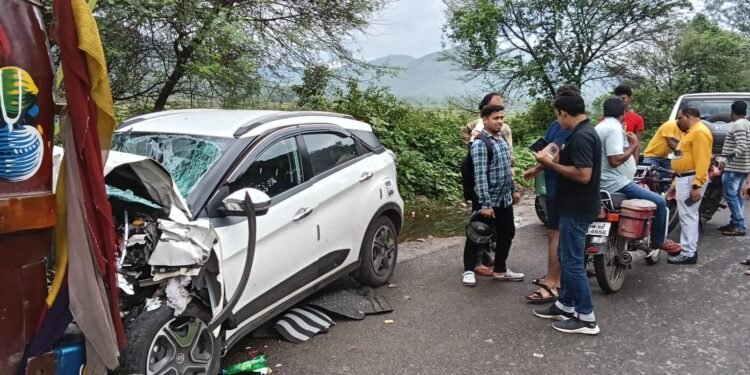
Bhubaneswar: The Odisha government is planning to overhaul its approach to road safety by prioritising the construction of “forgiving” roads and the creation of zero-fatality corridors across the State.
Official data indicates that 18,364 people lost their lives in road crashes between 2023 and 2025, driven largely by overspeeding, inadequate engineering and insufficient awareness.
The new push recognises that while accidents cannot always be avoided, their deadly consequences can be sharply reduced through better design, stronger emergency systems and model stretches that demonstrate crash-resilient infrastructure.
Transport officials explained that forgiving roads are engineered to limit the severity of collisions by incorporating clear zones free of roadside hazards, crash barriers, breakaway poles and gentler curves.
“Roads should be designed to absorb human error rather than punish it, and layouts should be intuitive enough to steer drivers toward safer behaviour. Forgiving roads minimise the fallout of mistakes, while self‑explaining roads use uniform design, signage, and visual cues to make the right choices obvious. The aim is to build networks that recognise human fallibility and channel it into safety,” a senior transport official said.
The strategy builds on a preparatory meeting chaired by the Minister for Law, Works and Excise Prithiviraj Harichandan at Lok Seva Bhawan. Pilot projects will begin on accident-prone corridors before expanding statewide, with the government exploring partnerships with technical institutes to adapt national and international best practices. Zero-fatality corridors are being identified on selected stretches of Public Works Department roads and national highways.
“These will serve as templates for transforming the entire network into a safer, crash‑resilient system,” the officer added.
To shape this next-generation road safety policy, the state will host a state-level technical workshop later this month, followed by regional workshops in Brahmapur, Rourkela, Sambalpur and Kataka. The events will bring together key stakeholders and domain experts from the Ministry of Road Transport and Highways (MoRTH), the National Highways Authority of India (NHAI), the Indian Roads Congress (IRC), the Central Road Research Institute (CRRI), and the State Commerce and Transport Department.
Discussions are expected to cover innovative engineering solutions, road safety audits, data-driven decision-making, emergency response, post-crash care and institutional reforms aimed at eventually achieving zero road fatalities. “These will serve as templates for transforming the entire network into a safer, crash‑resilient system,” the officer added.
Accident-prone locations and black spots will be mapped using findings from road safety audits as well as e-DAR and i-RAD data, with engineering corrections prioritised under the 2026-27 annual plan. “Junctions will be redesigned strictly as per Indian Roads Congress standards, while draft policies on pedestrian safety and wayside amenities are being finalised,” the officer said.
All black spots identified under MoRTH guidelines will be addressed without delay, and field units have been instructed to leave no hazardous location out of the annual plan.
To improve survival rates after crashes, the government intends to make highway patrolling mandatory across the national highway network and station ambulances at vulnerable points along national highways, state highways and major district roads. It will also urge MoRTH to include an Incident Management System in long-term maintenance contracts and new development projects.
The broader package further includes adoption of IRC standards for new intersections and grade-separated junctions, finalisation of a pedestrian safety policy and a wayside amenities policy, and pursuit of central approval for the proposed Bhubaneswar Outer Ring Road and Kataka Ring Road under MoRTH’s Urban Decongestion Policy.

Comments are closed.