


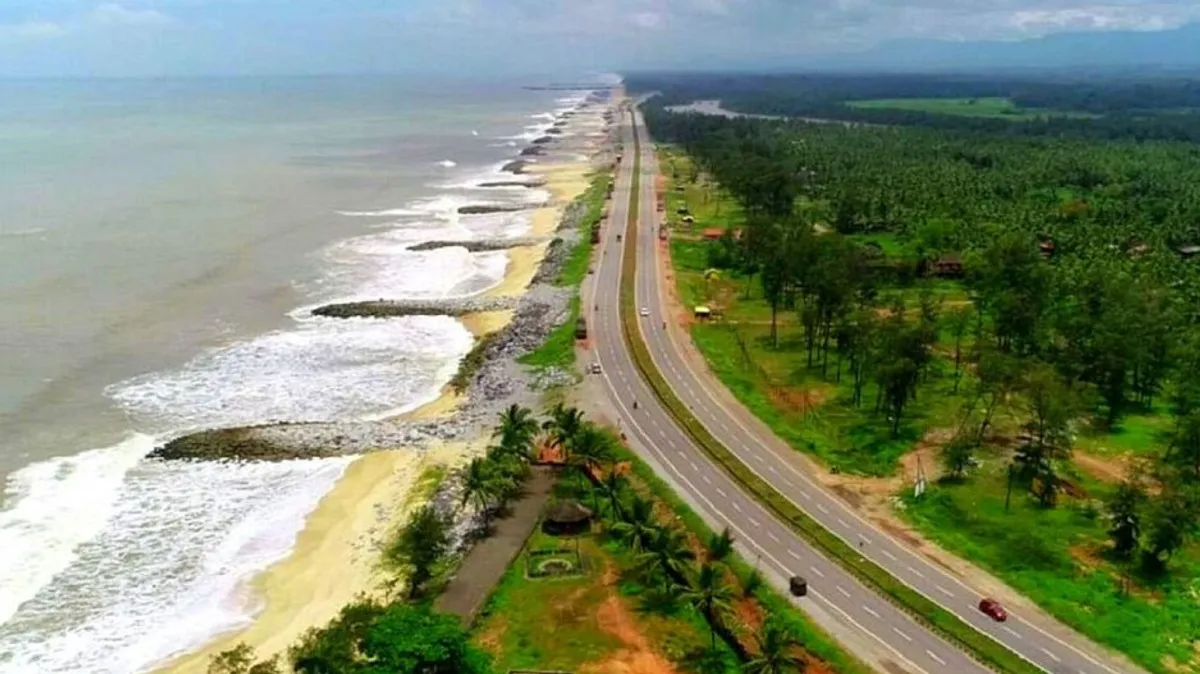
Bhubaneswar: In a significant development, the Union Cabinet on Wednesday approved a major portion of the ambitious Odisha coastal highway, connecting Rameshwar with Paradip, to be built at an estimated cost of Rs 8,300.79 crore.
The Cabinet Committee on Economic Affairs, chaired by Prime Minister Narendra Modi, gave the nod to the project on the Hybrid Annuity Model (HAM) in two packages at a total cost of Rs 8,300.79 crore. The new highway will pass through Khurda, Puri, Kendrapada, and Jagatsinghpur districts, providing much-needed alternative connectivity along Odisha’s coastline. The Ministry of Finance (MoF) had approved it in November 2025.
The project addresses longstanding limitations of the existing road network. While NH-16 forms part of the Golden Quadrilateral and is already a six-lane highway serving major urban centres like Khurda, Bhubaneswar, and Cuttack, stretches of NH-316 between Bhubaneswar–Puri, Puri–Satapada, and Puri–Konark suffer from poor geometry, heavy ribbon development along the corridor, and intense local traffic. These issues currently hinder smooth long-distance movement.
The new coastal highway will feature a 4-lane configuration from Rameshwar to Konark (Package-1) and a 2-lane road with paved shoulders from Konark to Paradip (Package-2), designed for a speed of 100 km per hour. Once completed, it is expected to slash travel time between Rameshwar and Paradip by about two hours and 30 minutes, offering safer, faster, and uninterrupted connectivity for both passengers and freight traffic.
The project has been planned in line with the PM Gati Shakti principles. It will link 9 Economic Nodes and 5 Logistic Nodes, which is likely to significantly improve logistics efficiency in the region and contribute to India’s overall Logistic Performance Index (LPI).
Officials expect the highway to bring substantial socio-economic benefits to coastal Odisha by enhancing regional mobility, reducing fuel consumption and vehicle operating costs, and lowering carbon emissions. The improved connectivity is also seen as a catalyst for tourism, trade, and industrial growth in the four districts it traverses.

Comments are closed.