


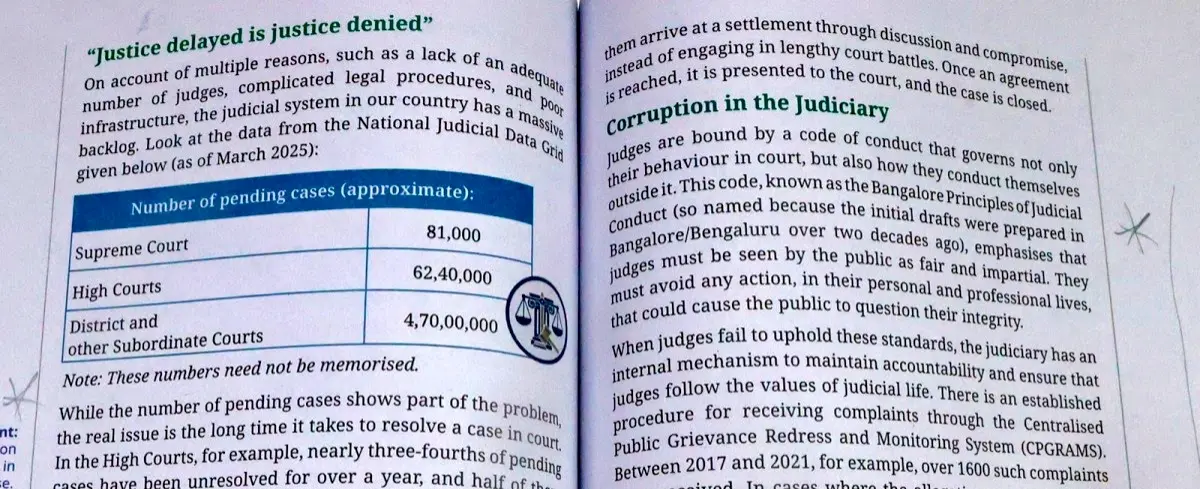
New Delhi: The Supreme Court on Wednesday ordered the Centre and all states to bar three NCERT panelists, including social science curriculum chairperson Prof Michel Danino, from any publicly funded work on textbooks, following their role in a controversial ‘Corruption in the Judiciary’ chapter for Class 8 students.
The bench, led by Chief Justice Surya Kant, directed dissociation of Prof Danino, Ms Diwakar, and Mr Alok Prasanna Kumar from preparing curricula, finalising textbooks, or rendering services to NCERT — even for future generations — if it involves public funds, ANI reported.
“At the outset we have no reason to doubt that professor Michel Danino along with Ms Diwakar and Mr Alok Prasanna Kumar either does not have reasonable knowledge about Indian judiciary or they deliberately knowingly misrepresented the facts in order to project a negative image of Indian judiciary before students of Class 8 who are at an impressionable age,” the bench observed in its order.
“There is no reason as to why such persons be associated in any manner with preparation of curriculum or finalisation of text book for the next generation. We direct union, all states, all institutions receiving state funds, to disassociate them from rendering any service which would mean payment to them from public funds,” the court said.
The order also mandates the Centre to constitute a panel of domain experts, including eminent jurists, to finalise curriculum on legal topics in NCERT textbooks. The bench expressed disappointment over the previous committee’s composition.
“We find it slightly disappointing that not a single eminent jurist is included in the committee,” it remarked, adding, “We direct that if at all Chapter 4 of the textbook has been rewritten, the same shall not be published unless it is approved by a committee of domain experts.”
This follows the court’s February 26 order imposing a blanket ban on publication, reprinting, or digital dissemination of the Class 8 social science book due to its “offending” contents on judicial corruption.
The bench clarified that its directions do not stifle legitimate critique. “We hasten to reiterate paragraph 9 of our order dated February 26 to show that the interim directions issued are not intended to prevent any healthy, objective and legitimate criticism of the functioning of the judiciary. If the judiciary is suffering from any deficiencies like any other institution, it will be a welcome step not only for the future generation of the nation, it will open doors for the present generation to take necessary remedial steps,” it noted.

Comments are closed.